



Top Over Center Buckle Strap Manufacturers for Global Buyers
Global buyers need more than a polished product photograph when evaluating an Over Center Buckle Strap manufacturer. They need evidence of consistent materials, controlled production, practical testing, and responsive communication. A strap may look simple, yet its performance depends on webbing strength, buckle geometry, stitching quality, coating durability, and correct installation.
Load-restraint engineer Michael R. Collins explains, “A buckle is only as trustworthy as the webbing, stitching, and installation around it.” This principle guides a careful supplier review. Reliable manufacturers should provide measurable specifications, including breaking strength, working load limits, buckle material, webbing width, and available corrosion protection. Factory audits, sample inspections, and batch records can reveal more than attractive catalogs. Small details matter.
The best choice is not always the lowest quotation. It may be the supplier that maintains stable tension after repeated use, protects edges from abrasion, and answers technical questions without vague promises. Buyers should examine production experience, export capability, customization support, packaging, and after-sales service. Ask for test reports. Check the stitching closely.
Still, no shortlist is perfect. Supplier websites can omit weaknesses, while laboratory figures may not reflect rough warehouse conditions, cold storage, vibration, or hurried operators. That gap deserves attention. A thoughtful comparison should combine documents, physical samples, factory evidence, and user feedback. This guide introduces leading Over Center Buckle Strap manufacturers for global buyers, highlighting where each company appears strong and where further verification remains sensible. Reliability is demonstrated over time, not claimed in a brochure.
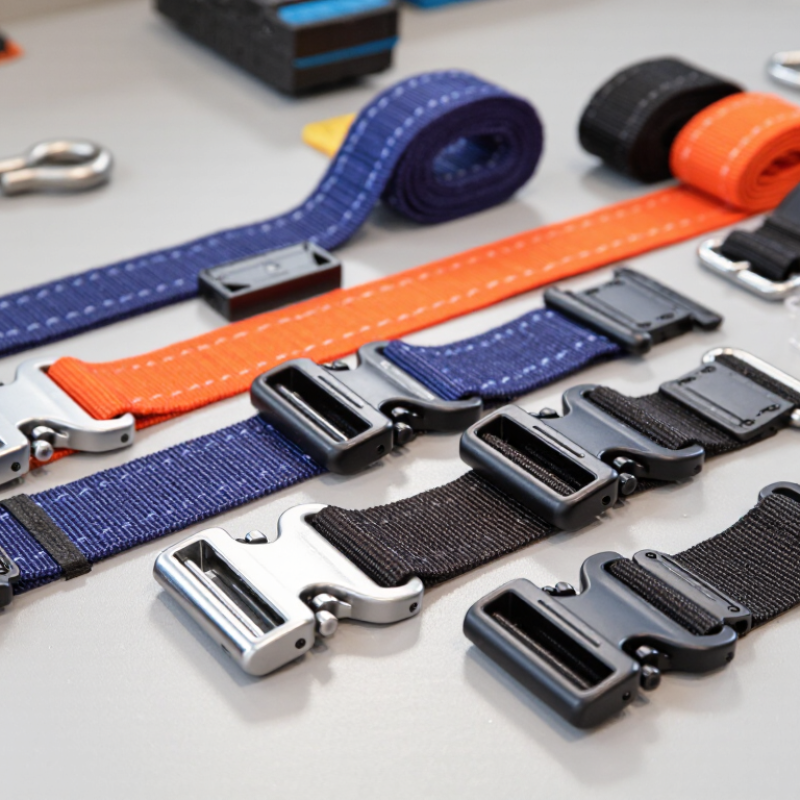
What Are Over Center Buckle Straps and How Do They Work?
Over center buckle straps are practical tensioning devices used to secure cases, cargo, panels, and equipment. They combine a buckle body, a pivoting lever, and a strap made from woven webbing. When the lever moves past the buckle’s center point, tension pulls it tighter instead of opening it. This creates a stable mechanical lock with little movement during handling.
The working process is simple. Thread the strap through the buckle, pull out slack, then press the lever over center. The final position should feel firm, not forced. During inspections, check stitching, edge wear, corrosion, and deformation around the pivot. Experienced buyers also compare breaking strength, working load, webbing width, and operating temperature. A buckle can look strong yet fail when the strap or attachment point is weaker. No design is perfect.
Tips: Choose the buckle according to real load conditions, not appearance alone. Leave enough strap length for adjustment, but avoid loose tails near moving parts. Test a sample under repeated tension before placing a large international order. Ask manufacturers for material details, dimensional drawings, quality records, and batch inspection procedures. Clear communication matters. Small measurement errors can cause installation delays. It is also wise to confirm whether the lever remains accessible after mounting, because a secure buckle is useless if workers cannot release it safely.
| Data Dimension | Typical Industry Information | How the Mechanism or Specification Works | What Global Buyers Should Verify |
|---|---|---|---|
| Product definition | An over-center buckle strap is a tensioning assembly that combines a webbing strap with a hinged buckle, lever, and anchor or loop. | The lever rotates beyond the buckle's center point, creating a locking action that maintains tension in the strap. | Confirm whether the quotation covers the complete assembly or only the metal buckle component. |
| Operating principle | Manual tensioning, over-center closure, and mechanical locking. | Pulling the strap removes slack; closing the lever increases tension; passing the pivot point helps prevent accidental opening during normal use. | Request installation instructions and verify that the buckle cannot be released unintentionally under the intended operating conditions. |
| Common strap widths | 25 mm, 38 mm, 50 mm, and 75 mm are common nominal webbing widths. | Wider webbing generally distributes contact pressure over a larger area, while the buckle, stitching, and anchor must be compatible with the selected width. | Check actual webbing width tolerance, buckle slot width, stitching allowance, and compatibility with the mounting surface. |
| Webbing materials | Polyester, polypropylene, and nylon are widely used synthetic webbing materials. | Polyester has low moisture stretch and good outdoor performance; polypropylene is lightweight and moisture-resistant; nylon offers high strength and elasticity but absorbs more moisture. | Compare tensile strength, elongation, UV resistance, abrasion resistance, chemical exposure, and operating temperature. |
| Buckle materials | Common choices include zinc-plated carbon steel, stainless steel, and coated steel. | The material and surface finish affect corrosion resistance, appearance, cost, and suitability for outdoor or marine environments. | Specify the steel grade or coating system, coating thickness where relevant, corrosion-test method, and environmental exposure level. |
| Stainless-steel options | 304 stainless steel is widely used for general corrosion resistance; 316 stainless steel is preferred for many marine or chloride-rich environments. | 316 stainless steel contains molybdenum, which generally improves resistance to chloride-related corrosion compared with 304 stainless steel. | Verify the exact material grade, whether all metal parts use the same grade, and whether welds, springs, pins, and hooks are included in the material declaration. |
| Load terminology | Breaking strength, rated capacity, working load limit, and assembly strength are different values. | The weakest component—webbing, buckle, stitching, hook, anchor, or attachment point—can determine the performance of the complete strap assembly. | Do not calculate a working load limit from webbing breaking strength alone. Request test data for the complete assembly and the intended application. |
| Load-restraint applications | Used for equipment covers, cargo restraint, cases, tarpaulins, luggage, outdoor products, and industrial enclosures. | The buckle provides repeatable manual tension without requiring a separate ratchet mechanism. | For road transport or safety-critical restraint, confirm the applicable legal requirements and use an assembly tested for that specific purpose. |
| Relevant transport reference | EN 12195-2 addresses web lashing requirements for load restraint, including performance information for lashing assemblies. | The standard is relevant when a strap is marketed for securing cargo, but compliance depends on the complete lashing design and declared parameters. | Ask for the applicable declaration, test report, labeling information, and assembly-level documentation rather than relying on a buckle-only claim. |
| End fittings | Common configurations include sewn loops, D-rings, flat hooks, wire hooks, snap hooks, and fixed mounting plates. | End fittings determine how the strap connects to the product and how loads are transferred to the anchor point. | Verify hook opening, wire diameter, hole size, mounting direction, edge radius, and compatibility with the anchor hardware. |
| Stitching construction | Box stitches, bar tacks, and reinforced multi-row stitching are commonly used at load-bearing connection points. | Stitch pattern, thread type, seam length, and webbing overlap influence the strength and durability of the connection. | Request a stitching diagram, thread specification, seam-strength test, and inspection criteria for skipped or broken stitches. |
| Adjustment range | Adjustment length is application-specific and is normally defined by the strap length, buckle geometry, and end-fitting position. | The strap must provide sufficient tail length for secure threading while avoiding excess loose webbing that could interfere with operation. | Specify minimum and maximum finished lengths, tolerance, tail length, adjustment direction, and whether custom lengths are required. |
| Environmental resistance | Important factors include UV exposure, rain, salt spray, abrasion, dust, oils, solvents, and temperature cycling. | Webbing and metal components may deteriorate at different rates, so the complete assembly must be evaluated as one system. | Define the operating environment and request material compatibility data or relevant test results for the complete product. |
| Safety features | Some designs use a secondary safety catch, locking tab, protected lever, or concealed release area. | These features can reduce accidental release caused by vibration, impact, or contact with nearby equipment. | Specify whether a secondary lock is mandatory and test opening force, release access, and vibration resistance in the final application. |
| Quality-control checks | Typical inspections include dimensions, webbing appearance, buckle operation, coating condition, stitching quality, and assembly strength. | Functional checks help identify misalignment, sharp edges, incomplete stitching, poor coating adhesion, or inconsistent tensioning performance. | Agree on sampling plans, visual standards, dimensional tolerances, test frequency, packaging checks, and nonconformance procedures. |
| Packaging and export handling | Straps are commonly supplied in bulk cartons, bags, reels, or individually labeled packs depending on the application. | Dry, clean packaging helps prevent moisture contamination, deformation, corrosion, and webbing damage during international transportation. | Confirm carton quantity, label language, barcode requirements, moisture protection, pallet configuration, and shipping marks. |
Related Posts
-
7 Best Over Center Buckle Strap Suppliers Worldwide?
-

Top Curtain Side Buckles for 2026 What to Look for?
-

2026 Best Over Center Buckle Types for Global Buyers?
-

How to Use Curtain Side Internal Straps at 2026 Canton Fair?
-
Top Skidder Tire Chains for Enhanced Traction in Tough Conditions?
-

2026 How to Use Polyester Composite Cord Strap Effectively?
Lashing&Lifting Equipment
Sitemap
polyester webbing sling, polyester round sling, 2inch ratchet tie down, ratchet tie down strap EN12195-2, 50MM 5T ratchet strap, eye webbing sling,
Latest News
Contact
-
Room709, Building 27, Shouchuang Airport International Center, No. 6 Changcheng South Road, Chengyang District, Qingdao, Shandong, China
-
7 Days a week from 10:00 am to 6:00 pm