



What Are China Top 10 Security Inspection Mirror Suppliers?
What Are China Top 10 Security Inspection Mirror Suppliers? This guide introduces manufacturers serving security, facility management, transport, and industrial inspection needs. It focuses on product quality, supplier experience, customization, and after-sales reliability.
A professional Security Inspection Mirror should provide a clear viewing area, balanced handling, and dependable lighting. Its mirror surface must resist distortion during close inspection. Telescopic poles should extend smoothly without unwanted movement. Wheels, joints, grips, and battery compartments also deserve careful attention. Small weaknesses often become obvious during repeated daily use. Buyers should request material specifications, inspection records, sample photos, and realistic delivery information. Factory audits and independent testing can strengthen purchasing confidence.
Bruce Schneier, a respected security technology expert, said, “Security is a process, not a product.” This principle applies directly here. A mirror is only one part of a complete inspection procedure. Supplier training, replacement parts, packaging, and technical support matter too. No ranking is flawless. A supplier with excellent pricing may offer limited customization. Another may produce strong equipment but communicate slowly. These trade-offs require honest comparison. The following overview therefore considers manufacturing capability, application fit, quality consistency, and long-term service. It avoids treating promotional claims as proven evidence. Readers should still verify certifications, production capacity, and current customer references before making a final decision. That extra step may feel slow. It often prevents expensive mistakes.
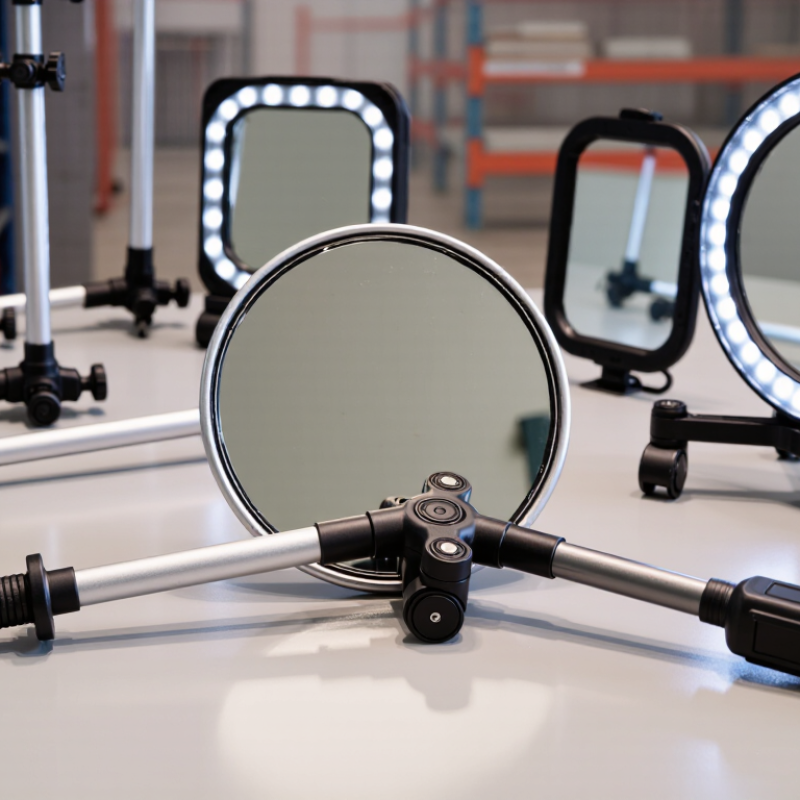
What Are Security Inspection Mirrors and How Do They Work?
Security inspection mirrors are practical tools for viewing areas that normal eyesight cannot reach. A convex mirror reflects a wider field, while a small flashlight improves visibility beneath vehicles, shelving, doors, and machinery. The mirror usually connects to an adjustable handle, allowing an operator to inspect corners without bending or entering restricted spaces. Simple equipment.
In professional inspections, the mirror’s optical clarity, frame strength, handle length, and wheel quality matter. A stable swivel joint helps users adjust the viewing angle smoothly. Scratch-resistant surfaces are valuable in busy facilities. The best suppliers also provide clear specifications, replacement parts, protective cases, and responsive technical support. These details help buyers compare the top ten suppliers more fairly than price alone.
From practical use, lighting often affects results more than expected. A clean mirror can still produce a poor image in a dark parking area or dusty workshop. Operators should check the mirror before each inspection and avoid rushing the viewing process. However, these tools do not replace trained personnel, cameras, or established safety procedures. Some narrow spaces remain difficult to inspect. This limitation deserves honest attention when selecting equipment. Suppliers with inspection experience should explain realistic viewing distances, maintenance needs, and suitable applications instead of making exaggerated claims.
What Are China Top 10 Security Inspection Mirror Suppliers? - What Are Security Inspection Mirrors and How Do They Work?
| Profile | Primary Supplier Specialization | Main Mirror Type | Typical Mirror Material | Common Size Range | Typical Viewing Use | Common Applications | Key Selection Factors |
|---|---|---|---|---|---|---|---|
| 01 | Under-vehicle inspection equipment | Portable under-vehicle mirror | Acrylic or polycarbonate convex mirror | Mirror diameter: 200–300 mm; handle: 600–1,200 mm | Wide-angle inspection beneath vehicles | Vehicle checkpoints, parking facilities, logistics yards | Wheel durability, low weight, rolling stability, scratch resistance |
| 02 | Telescopic inspection tools | Extendable convex inspection mirror | Impact-resistant acrylic or glass | Mirror diameter: 150–300 mm; extended length: up to about 2 m | Areas hidden behind or below fixed structures | Factories, warehouses, transport hubs, maintenance areas | Locking mechanism, handle strength, corrosion resistance, portability |
| 03 | Outdoor security mirror systems | Weather-resistant convex mirror | UV-stabilized acrylic or polycarbonate | Diameter: 300–1,000 mm; rectangular formats also available | Traffic and pedestrian blind-spot visibility | Factory entrances, loading bays, roads, underground garages | UV protection, waterproof housing, mounting hardware, viewing distance |
| 04 | Handheld inspection mirror production | Handheld security search mirror | Convex acrylic with aluminum or stainless-steel frame | Mirror diameter: 100–250 mm; handle: 300–800 mm | Close-range inspection of concealed surfaces | Security screening, event venues, public buildings | Ergonomic grip, frame stability, image clarity, easy cleaning |
| 05 | LED-assisted inspection products | Illuminated telescopic mirror | Acrylic or glass convex mirror with LED lighting | Mirror diameter: 150–300 mm; LED housing: compact integrated type | Dark, enclosed, or poorly lit inspection locations | Vehicle inspection, industrial maintenance, storage areas | Battery life, switch protection, light coverage, water resistance |
| 06 | Heavy-duty industrial inspection | Industrial undercarriage mirror | Coated glass or reinforced polycarbonate | Mirror diameter: 300–600 mm; reinforced frame and wheel assembly | Large-area inspection under trucks and machinery | Ports, mines, factories, construction and transport depots | Load capacity, wheel quality, frame protection, resistance to dust and impact |
| 07 | Baggage and parcel inspection accessories | Compact convex search mirror | Lightweight acrylic or polycarbonate | Mirror diameter: 100–200 mm; compact hand-held design | Inspection of luggage bases, shelves, and narrow gaps | Airports, stations, hotels, offices, mailrooms | Low weight, compact storage, impact resistance, hygienic surface |
| 08 | Custom traffic and facility mirrors | Large-format convex safety mirror | Outdoor-grade acrylic with protective backing | Diameter: 600–1,200 mm; custom rectangular sizes possible | Long-distance visibility at entrances and intersections | Industrial campuses, warehouses, parking structures, road junctions | Optical distortion control, mounting angle, wind resistance, visibility distance |
| 09 | Multi-angle inspection equipment | Adjustable-angle inspection mirror | Acrylic convex mirror with metal or reinforced polymer joints | Mirror diameter: 150–300 mm; rotating or tilting head | Flexible viewing around corners and obstacles | Security patrols, equipment rooms, service corridors | Joint reliability, angle retention, handle rigidity, replacement parts |
| 10 | OEM and project-based mirror manufacturing | Customized security inspection mirror assemblies | Acrylic, polycarbonate, coated glass, or specified composite materials | Custom dimensions, mounting systems, handles, and accessories | Applications defined by site layout and inspection procedure | Government facilities, transport projects, industrial security programs | Technical drawings, sampling, quality inspection, packaging, export compliance |
Related Posts
-
China Top 10 Security Inspection Mirror Suppliers?
-
How to Choose the Best Pull Down Ratchet Straps for Your Needs?
-
Best Pull Down Ratchet Straps for Secure Cargo Transport?
-

2026 How to Choose Composite Cord Strap for Global Sourcing?
-
Top Skidder Tire Chains for Enhanced Traction in Tough Conditions?
-

2026 How to Use Curtain Side Straps for Better Window Treatment?
Lashing&Lifting Equipment
Sitemap
polyester webbing sling, polyester round sling, 2inch ratchet tie down, ratchet tie down strap EN12195-2, 50MM 5T ratchet strap, eye webbing sling,
Latest News
Contact
-
Room709, Building 27, Shouchuang Airport International Center, No. 6 Changcheng South Road, Chengyang District, Qingdao, Shandong, China
-
7 Days a week from 10:00 am to 6:00 pm