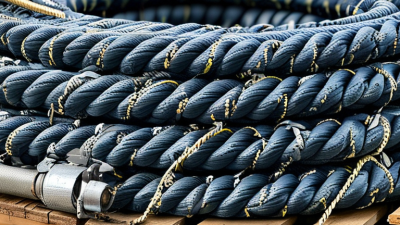
Choosing the China Best Polyester Composite Cord Strap manufacturer requires more than comparing export prices. This product secures cartons, timber bundles, insulation panels, and palletized machinery during handling. A reliable supplier understands tension, friction, moisture, and uneven loads. Those details often decide whether cargo arrives stable or damaged. Polyester Composite Cord Strap combines high-strength polyester yarns with a protective coating. It can offer flexibility without sharp metal edges. However, performance depends on construction, not the product name alone.
A capable manufacturer should explain yarn strength, strap width, breaking force, elongation, and buckle compatibility. Product samples should be checked by hand and tested under realistic tension. Watch how the strap grips a painted pallet corner. Notice whether the buckle slips after repeated tightening. Packaging also matters. Rolls should remain dry, clean, and protected from crushing during storage and transport. Clear batch labels support traceability. Factory photographs help, but documented inspection records provide stronger evidence. Claims without data are weak.
No supplier is perfect. Even a professional factory may face material changes, seasonal moisture, or inconsistent operator training. That is why dependable sourcing includes communication, quality control, and corrective action. Ask how rejected rolls are handled. Ask whether production samples match shipped orders. A responsible manufacturer will answer plainly. Experience also shows that the cheapest quotation can create hidden costs through rework, damaged cargo, or delayed delivery. This guide examines manufacturing capability, technical standards, customization, packaging, and after-sales support. Its goal is practical judgment, not exaggerated praise. The best choice should protect cargo consistently, communicate honestly, and improve when problems appear.
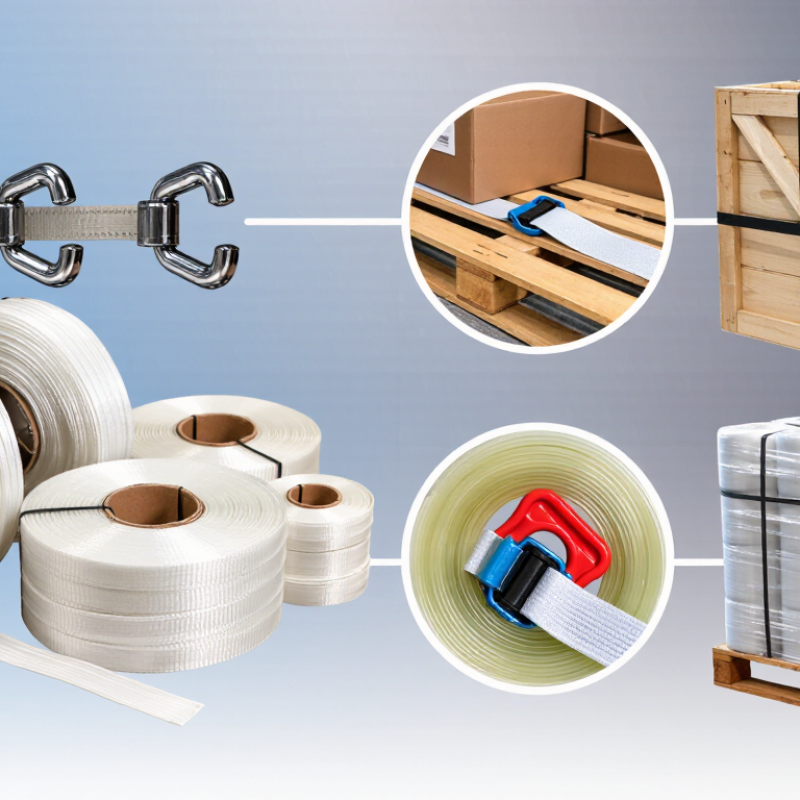
A polyester composite cord strap is a flexible load restraint made from high-tenacity polyester yarns. These yarns run lengthwise and receive a protective polymer coating. The coating binds the cords, improves handling, and helps resist moisture, abrasion, and ultraviolet exposure. Unlike rigid steel strapping, it feels softer against painted surfaces and packaged edges. It can also be tensioned with hand tools. That matters on busy packing lines.
In practical packing work, operators wrap it around cartons, timber bundles, pipes, and machinery. The strap spreads pressure across several yarns instead of relying on one flat strip. A buckle or friction joint locks the tension without heat. However, the joint remains the critical point. Poor threading, sharp corners, or insufficient overlap can reduce holding strength. Edge protectors and correct tensioning are not optional details.
Reliable selection requires checking breaking strength, elongation, coating quality, and tested joint performance. Ask for batch records and samples before approving regular supply. A strap may look strong yet stretch too much under vibration. That weakness is easy to miss. My own assessment would include a trial shipment, not only a catalogue number. The material is practical, but no restraint product replaces proper load distribution and inspection. Even experienced teams sometimes tension by feel. That habit deserves reconsideration.
Polyester composite cord strap is a woven polyester tensioning material reinforced with longitudinal cords and coated for improved handling. The chart shows representative break-strength levels commonly specified for different strap widths; actual values vary by construction and manufacturer.
Wider straps generally contain more reinforcement and can provide higher tensile strength for securing heavy loads, while remaining lightweight and resistant to corrosion.
Polyester composite cord strap begins with high-tenacity polyester yarn. The yarn is drawn and heat-set to improve strength and dimensional stability. Several yarn bundles are then arranged in parallel, like fine cables across a production line. Tension matters here. Uneven tension can create weak zones later.
The aligned cords pass through a coating unit filled with a heated polymer compound. Heat allows the compound to flow around each cord and bind the structure together. Rollers shape the material into a flat strap with consistent thickness. It then moves through cooling rollers or a controlled air section. This hardens the coating without damaging the polyester core. Some designs use additional surface treatment for better friction and handling.
Manufacturers inspect the strap during production, not only at the end. Typical checks include width, thickness, linear density, breaking strength, elongation, and coating adhesion. Samples may also undergo bending and tension tests. In real production, small defects can appear. A slightly rough edge, uneven coating, or loose cord may affect performance. That is why experienced technicians adjust temperature, line speed, and yarn tension together. The process is reliable, but never perfectly automatic. Good records and repeat testing remain essential for stable quality.
China Best Polyester Composite Cord Strap Manufacturer?
What makes a reliable cord strap manufacturer? Consistent tensile performance is the starting point, not the finish. A dependable factory controls polyester yarn quality, coating weight, weaving tension, and curing temperature. Small variations can affect grip, elongation, and load stability. Ask for batch records and recent test certificates. ASTM D3950 offers a recognized framework for nonmetallic strapping performance.
Testing should reflect actual warehouse conditions. Samples need checks for tensile strength, elongation, weld or buckle holding force, abrasion, and moisture exposure. A strong supplier can explain test methods without hiding behind technical language. That matters. OECD’s Global Plastics Outlook reported 353 million tonnes of plastic waste in 2019, while only 9% was recycled. Better material efficiency and controlled production therefore deserve attention. Recycled polyester may reduce virgin material use, but it can also change strength consistency. The supplier should prove performance, not simply make a sustainability claim.
Reliability also depends on traceability. Each shipment should link to a production date, material batch, operator record, and inspection result. Clear packaging prevents crushed coils and damaged edges during transport. Factory audits should examine calibration, worker training, storage humidity, and corrective-action records. One overlooked issue remains common: suppliers may test new samples but neglect aging tests. That weakness deserves honest discussion. A manufacturer becomes more credible when it admits limits, investigates failures, and improves the process with measurable evidence.
A practical evaluation table based on measurable product, quality-control, and supply-chain criteria
| Evaluation Dimension | Typical Industry Reference | What a Reliable Manufacturer Should Provide | Recommended Verification Method |
|---|---|---|---|
| Strap Material | High-tenacity polyester yarn embedded in or coated with a polymer matrix. | Consistent yarn quality, uniform coating, good resistance to moisture, abrasion, and most common chemicals. | Review the technical data sheet, raw-material specification, coating description, and batch traceability records. |
| Common Width Options | Common commercial widths include approximately 13 mm, 16 mm, 19 mm, 25 mm, and 32 mm. | Stable width and thickness within an agreed tolerance, with clear identification for every size. | Measure samples with calibrated gauges and compare results with the approved drawing or purchase specification. |
| Breaking Strength | Commercial products commonly range from several hundred to more than 2,000 daN, depending on width, yarn construction, and product design. | Publishes minimum breaking strength rather than only an average value and maintains consistent results between production lots. | Request test reports using a recognized method such as ASTM D6775 or another applicable textile-webbing tensile standard. |
| Elongation at Break | Polyester composite cord straps generally show lower elongation than many polypropylene alternatives; the actual value depends on construction and test conditions. | Defines elongation at a stated load or at break and uses the same test speed, gauge length, and conditioning procedure for comparison. | Check the test method and test conditions before comparing elongation figures from different suppliers. |
| Cord and Coating Uniformity | A uniform surface should be free from exposed yarn, major lumps, pinholes, loose fibers, and irregular coating thickness. | Uses in-process visual inspection and dimensional checks to reduce weak points and feeding problems. | Inspect a complete roll or multiple roll sections under consistent lighting and record defect rates by batch. |
| Buckle Compatibility | The strap width, thickness, and surface friction must match the selected metal or polymer buckle. | Provides confirmed buckle compatibility and assembly guidance for manual, pneumatic, or battery-powered tools. | Conduct pull tests on the complete strap–buckle assembly, not only on the strap material. |
| Joint and Load Retention | Load retention depends on strap tension, buckle design, threading method, and surface condition. | Documents joint efficiency and provides application instructions to prevent incorrect threading or insufficient tension. | Test the complete joint under static loading and, when relevant, under vibration or repeated loading. |
| Safety and Application Limits | Breaking strength is not the same as Working Load Limit. The applicable safety factor and use conditions must be specified. | Clearly separates minimum breaking strength, lashing capacity, working load guidance, and prohibited applications. | Review labels, technical documents, and applicable requirements such as EN 12195-2 when the product is marketed as a load-restraint assembly. |
| Quality Management | A documented quality system should control incoming materials, production parameters, inspection, nonconformities, and corrective actions. | Maintains inspection records, calibration records, lot numbers, and a traceable complaint-handling process. | Request a current quality-system certificate where relevant and audit the actual production and inspection procedures. |
| Testing Capability | Essential tests include width, thickness, mass per unit length, breaking strength, elongation, and buckle or joint performance. | Uses calibrated tensile-testing equipment and retains original test data for production lots. | Verify equipment calibration dates, test conditions, sample quantity, and whether results represent the finished product. |
| Packaging and Storage | Polyester is moisture resistant, but rolls should still be protected from contamination, sharp edges, excessive heat, and prolonged ultraviolet exposure. | Uses labeled rolls, protective packaging, pallet stability controls, and defined storage conditions. | Check packaging integrity, roll identification, net weight, batch number, and storage recommendations at receipt. |
| Customization and Sampling | Customized width, color, roll length, packaging, and buckle combinations are common requirements for industrial buyers. | Confirms specifications in writing, supplies pre-production samples, and obtains approval before mass production. | Compare the approved sample with the first production lot for dimensions, appearance, strength, and packaging. |
| Export and Delivery Reliability | Reliable supply requires stable lead times, accurate commercial documents, suitable export packaging, and clear shipment communication. | Provides a realistic production schedule, pre-shipment inspection documents, packing details, and prompt handling of deviations. | Evaluate delivery performance over multiple orders rather than judging reliability from a single shipment. |
Choosing a China-based polyester composite cord strap supplier requires more than comparing prices. The World Bank’s 2023 Logistics Performance Index ranked China 19th among 139 economies, but national performance cannot guarantee one factory’s reliability. Request a production address, export history, process flow, and recent batch records. Then verify them through a live video audit or independent inspection.
Check the strap’s breaking strength, elongation, width, and joint quality. Ask for test reports linked to a batch number, not a generic certificate. ASTM D3950 can support strapping evaluation, while EN 12195-2 may matter for load-restraint applications. The ISO Survey 2022 recorded 426,716 ISO 9001 certificates in China. Certification helps, but it does not replace process evidence. Inspect resin storage, weaving tension, coating uniformity, and heat-sealed joints.
Look closely at samples. Feel the surface.
A supplier should provide test results before shipment and retain samples afterward. Confirm whether stated breaking strength reflects new material, conditioned material, or a production average. Those figures are not interchangeable. In practice, buyers sometimes focus too heavily on tensile strength and miss poor joint performance. That is a costly blind spot. My evaluation would still include a small trial order, because documents can look complete while pallet-level consistency remains uncertain. Review packaging, moisture protection, carton markings, lead time, complaint handling, and corrective-action records before approving regular purchases.
Polyester composite cord strap is widely used where cargo needs firm restraint without sharp edges. Logistics companies apply it to pallets of cartons, furniture, machinery parts, and building materials. Its woven polyester cords provide strong tension, while the flexible surface helps reduce scratches on painted or polished goods. Warehouses also value its low weight. Workers can carry several straps during a loading shift.
The furniture industry uses it around sofas, cabinets, mattresses, and flat-packed panels. Construction suppliers secure pipes, insulation boards, timber, and prefabricated components before transport. In appliance distribution, the strap helps stabilize boxed refrigerators, washing machines, and other large products. Agricultural businesses use it for bundled irrigation pipes, feed bags, and lightweight equipment. It performs well when loads need repeated handling.
Field experience shows that correct tension matters more than simply choosing a stronger strap. Excessive tightening may crush cartons or deform soft products. Loose strapping can allow movement during braking, cornering, or lifting. Operators should inspect the strap for cuts, frayed cords, moisture damage, and worn buckles. Small defects matter. A common mistake is using one strap pattern for every cargo type. That approach saves minutes but can create instability. Load shape, weight distribution, transport distance, and handling equipment should guide the securing method. Periodic training also improves consistency, although rushed loading still causes avoidable errors.